When the sequence of numbers (or a1, a2, a3,...) increases or decreases by a fixed quantity, then the sequence is in arithmetic progression (A.P.). The fixed quantity is called as common difference. For an AP, we define its first term as a and the common difference as d. The general expression for an AP is: a, a + d, a + 2d, a + 3d,....
If Tr represents the gernal term of an AP, then where


In an AP, the difference of any two consecutive terms is d and is given by:

Sum of n terms of an AP
Consider n terms of an AP with first term as a and common difference as d. Let Sn denote the sum of first n terms, then

![{\displaystyle S_{n}={\frac {n}{2}}[2a+(n-1)d]}](https://services.fandom.com/mathoid-facade/v1/media/math/render/svg/cbc143c3c13fc23d46426e4c0cac23bafb3f500e)
where


Arithematic Mean
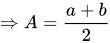
To understand the topic better, go to Arithmetic mean. When three quantities are in AP, then the middle one is called as arithmetic mean of other two. If a and b are two numbers and A be the arithmetic mean of a and b, then a, A, b are in AP.

 |
This article is a stub. You can help Math Wiki by expanding it. |