The cylindrical coordinate system is similar to that of the spherical coordinate system, but is an alternate extension to the polar coordinate system. Its elements, however, are something of a cross between the polar and Cartesian coordinates systems.
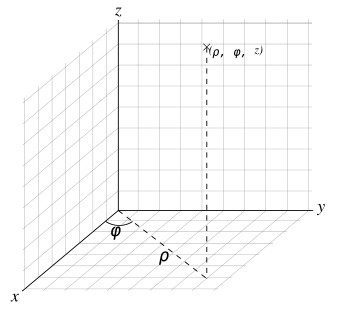
The coordinate system uses the standard polar coordinate system in the x-y plane, utilizing a distance from the origin (r) and an angle (θ) of extension from the positive x-axis (or pole). However, the third coordinate is a simple z-axis distance from above the x-y plane, just as any standard Cartesian system would utilize.
The coordinate represents the coordinate that exists at height h above the x-y plane (the z-coordinate). While, looking down from above, onto the x-y plane, the coordinate would appear to be at the polar coordinate (r, θ)

Conversion
Given the coordinates:
- Spherical:
- Cylindrical:
- Cartesian:


Spherical coordinates may be converted to cylindrical coordinates by:


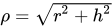
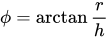
Cylindrical coordinates may be converted to spherical coordinates by:

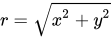
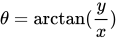
Cartesian coordinates may be converted into cylindrical by:

Cylindrical coordinates may be converted into Cartesian by:


