Which is subject to and . One may form an auxiliary equation in accordingly and solve for .
Through the use of the quadratic formula, one will obtain,
or equivalently
So we have,
where and are constants to be determined. Substituting the values we have
Solving for both variables, we obtain,
So, one has
as required.
Sum
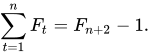
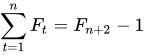
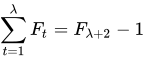
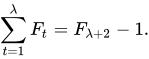
For all integers ,
Proof
Proposition: given
as defined above,
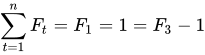
Let ,
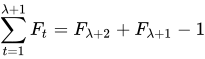
Therefore the proposition holds for . Assume that the proposition holds for . We may now make use of the inductive step. Let .
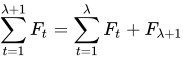
.
We know that
from the assumption that the proposition holds for .
So, we have,
Using the definition,
one obtains
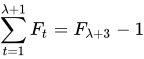
which obeys the proposition
As the proposition holds for , and , the proposition holds for all natural numbers.
Binet's Formula
Binet's Formula is a theorem that allows one to determine , where represents the Fibonacci Number.
The theorem is as follows:
Lucas sequence
The recursive effect from the Fibonacci sequence can also be applied with other starting numbers, like the Lucas numbers, which start with 2 and 1, instead of 0 and 1.
Trivia
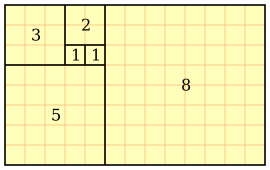
Fibonacci numbers are claimed to be common in nature; for example, the shell of a nautilus being a Fibonacci spiral. However, this has been disputed with the spiral having a ratio measured between 1.24 to 1.43.[1]

















![{\displaystyle F_{n}={\frac {1}{\sqrt {5}}}\left(\phi ^{n}-[1-\phi ]^{n}\right)}](https://services.fandom.com/mathoid-facade/v1/media/math/render/svg/ac110385f5a7356dd6eaf255fe950ea033e13dfa)