
A triangle (black) with incircle (blue), incentre (I), excircles (orange), excentres (JA,JB,JC), internal angle bisectors (red) and external angle bisectors (green)
In geometry, the incircle or inscribed circle of a polygon is the largest circle contained in the polygon; it touches (is tangent to) the many sides. The center of the incircle is called the polygon's incenter.
An excircle or escribed circle of the polygon is a circle lying outside the polygon, tangent to one of its sides and tangent to the extensions of the other two. Every polygon has many distinct excircles, each tangent to one of the polygons sides.
The center of the incircle can be found as the intersection of the many internal angle bisectors. The center of an excircle is the intersection of the internal bisector of one angle and the external bisectors of the other two. From this, it follows that the center of the incircle together with the many excircle centers form an orthocentric system.
See also Tangent lines to circles.
Relation to area of the triangle
The radii of the in- and excircles are closely related to the area of the triangle. Let A be the triangle's area and let a, b and c, be the lengths of its sides. By Heron's formula, the area of the triangle is

where is the semiperimeter.

Radius
The radius of the incircle (AKA the inradius) is

Diameter
The diameter of the incircle is:

Others
The excircle at side a has radius

Similarly the radii of the excircles at sides b and c are respectively

and

From these formulas we see in particular that the excircles are always larger than the incircle, and that the largest excircle is the one attached to the longest side.
Area

The area of the incircle is:


From a right triangle:

Perimeter

The perimeter of the incircle is:


From a right triangle:

Incircles of polygons
The inradius of a regular n-sided polygon is:

The diameter of incircle:

Area and Perimeter
Incircle area:

Incircle perimeter:

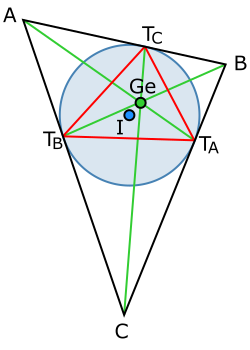
A triangle, ΔABC, with incircle (blue), incentre (blue, I), contact triangle (red, ΔTaTbTc) and Gergonne point (green, Ge)
Nine-point circle and Feuerbach point
The circle tangent to all three of the excircles as well as the incircle is known as the nine-point circle. The point where the nine-point circle touches the incircle is known as the Feuerbach point.
Gergonne triangle and point
The Gergonne point of a triangle is the symmedian point of its contact triangle. Denoting the three vertices of the triangle by A, B and C and the three points where the incircle touches the triangle by TA, TB and TC (where TA is opposite of A, etc.), the triangle TATBTC is known as the contact triangle or Gergonne triangle of ABC. The incircle of ABC is the circumcircle of TATBTC. The three lines ATA, BTB and CTC intersect in a single point, the triangle's Gergonne point G.
The contact triangle is also called the intouch triangle, and the touchpoints of the excircle with segments BC,CA,AC are the vertices of the extouch triangle. The Gergonne triangle is also called the excentral triangle, and the points of intersection of the interior angle bisectors of ABC with the segments BC,CA,AB are the vertices of the incentral triangle.
Trilinear coordinates for the vertices of the intouch triangle are given by


Trilinear coordinates for the vertices of the extouch triangle are given by


Trilinear coordinates for the vertices of the incentral triangle are given by


Trilinear coordinates for the vertices of the excentral triangle are given by


Trilinear coordinates for the Gergonne point are ,

or, equivalently, by the Law of Sines, .

Coordinates of the incenter
The Cartesian coordinates of the incenter are a weighted average of the coordinates of the three vertices. (The weights are positive so the incenter lies inside the triangle as stated above.) If the three vertices are located at , , and , and the opposite sides of the triangle have lengths , , and , then the incenter is at


- .


- Trilinear coordinates for the incenter are 1 : 1 : 1.
- Barycentric coordinates for the incenter are a : b : c.
Equations for four circles
Let x : y : z be a variable point in trilinear coordinates, and let u = cos2(A/2), v = cos2(B/2), w = cos2(C/2). The four circles described above are given by these equations:
- Incircle: u2x2 + v2y2 + w2z2 - 2(vwyz - wuzx - uvxy) = 0
- A-excircle: u2x2 + v2y2 + w2z2 - 2(vwyz + wuzx + uvxy) = 0
- B-excircle: u2x2 + v2y2 + w2z2 + 2(vwyz - wuzx + uvxy) = 0
- C-excircle: u2x2 + v2y2 + w2z2 + 2(vwyz + wuzx - uvxy) = 0
See also
- Altitude (triangle)
- Circumscribed circle
- Inscribed sphere
- Power of a point
- Steiner inellipse
References

|
This page uses content from Wikipedia. The original article was at Inscribed circle. The list of authors can be seen in the page history. As with the Math Wiki, the text of Wikipedia is available under the Creative Commons Licence. |
- Clark Kimberling, "Triangle Centers and Central Triangles," Congressus Numerantium 129 (1998) i-xxv and 1-295.
- Sándor Kiss, "The Orthic-of-Intouch and Intouch-of-Orthic Triangles," Forum Geometricorum 6 (2006) 171-177.
External links
Template:External
- Triangle centers by Antonio Gutierrez from Geometry Step by Step from the Land of the Incas.
- Transitivity in Action — Remarkable Points in a Triangle at cut-the-knot
- Incenters in Cyclic Quadrilateral at cut-the-knot
- Equal Incircles Theorem at cut-the-knot
- Five Incircles Theorem at cut-the-knot
- Pairs of Incircles in a Quadrilateral at cut-the-knot
- Triangle incenter Triangle incircle Incircle of a regular polygon With interactive animations
- Constructing a triangle's incenter / incircle with compass and straightedge An interactive animated demonstration
- Incircles
- An interactive Java applet for the incenter