In geometry, a kite, or deltoid is a quadrilateral with two disjoint pairs of congruent adjacent sides, in contrast to a parallelogram, where the congruent sides are opposite. The geometric object is named for the wind-blown, flying kite (itself named for a bird), which in its simple form often has this shape.
Equivalently, a kite is a quadrilateral with an axis of symmetry along one of its diagonals. A quadrilateral that has an axis of symmetry must be either a kite or an isosceles trapezoid. Kites and isosceles trapezoids are dual: the polar figure of a kite is an isosceles trapezoid, and vice versa.[1]
A kite may be either convex or concave; a concave kite is sometimes called a "dart", and is a type of pseudotriangle.
Properties
- The two diagonals of a kite are perpendicular.
- Two interior angles at opposite vertices of a kite are equal.
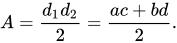
- The area of a kite is half the product of the lengths of its diagonals: Alternatively, if a and b are the lengths of two unequal sides, and θ is the angle between unequal sides, then the area is ab sin θ.
- One diagonal divides a (convex) kite into two isosceles triangles; the other (the axis of symmetry) divides the kite into two congruent triangles.
- Every convex kite has an inscribed circle; that is, there exists a circle that is tangent to all four sides. Therefore, every convex kite is a tangential quadrilateral. Additionally, if a convex kite is not a rhombus, there is another circle, outside the kite, tangent to all four sides, suitably extended. For every concave kite there exist two circles tangent to all four (possibly extended) sides: one is interior to the kite and touches the two sides opposite from the concave angle, while the other circle is exterior to the kite and touches the kite on the two edges incident to the concave angle.[2]
Special cases
- A kite is a cyclic quadrilateral, that is, can be inscribed in a circle, if and only if it is formed from two congruent right triangles.[3]
- If all four sides of a kite are the same length (that is, if the kite is equilateral), it is a rhombus.
- If a kite is equiangular, it must also be equilateral and thus a square.
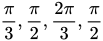
- Kites and darts in which the two isosceles triangles forming the kite have apex angles of and represent one of two sets of essential aperiodic tiles isolated by mathematical physicist Roger Penrose.


- All kites tile the plane by repeated inversion around the midpoints of their edges, as do more generally all quadrilaterals. A kite with angles can also tile the plane by repeated reflection across its edges; the resulting tessellation, the deltoidal trihexagonal tiling, superposes a tessellation of the plane by regular hexagons and isosceles triangles.[5]
- The deltoidal icositetrahedron, deltoidal hexecontahedron, and trapezohedra are polyhedra with congruent kite-shaped facets.
References
- ↑ Robertson, S. A. (1977), "Classifying triangles and quadrilaterals", Mathematical Gazette 61 (415): 38–49, http://www.jstor.org/view/00255572/ap060416/06a00060/0.
- ↑ Wheeler, Roger F. (1958), "Class room notes: quadrilaterals", Mathematical Gazette 42 (342): 275–276, http://www.jstor.org/view/00255572/ap060343/06a00090/0.
- ↑ Gant, P. (1944), "A note on quadrilaterals", Mathematical Gazette 28 (278): 29–30, http://www.jstor.org/view/00255572/ap060279/06a00130/0.
- ↑ Ball, D. G. (1973), "A generalisation of π", Mathematical Gazette 57 (402): 298–303, http://www.jstor.org/view/00255572/ap060403/06a00080/0; Griffiths, David; Culpin, David (1975), "Pi-optimal polygons", Mathematical Gazette 59 (409): 165–175, http://www.jstor.org/view/00255572/ap060410/06a00060/0.
- ↑ See Weisstein, Eric W., "Kite" from MathWorld..
External links
- Kite definition and area formulae with interactive animations.