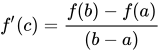
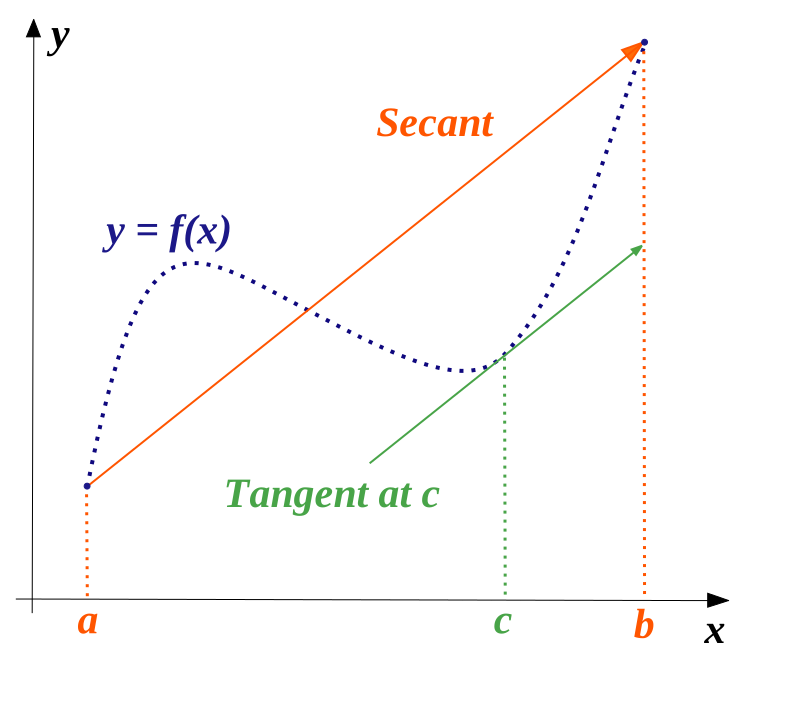
The mean value theorem states that in a closed interval, a function has at least one point where the slope of a tangent line at that point (i.e. the derivative) is equal to the average slope of the function (or the secant line between the two endpoints).
Ergo:
on a closed interval has a derivative at point , which has an equivalent slope to the one connecting and .
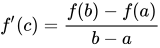
Therefore, the derivative equals the slope formula:
There are three formulations of the mean value theorem:
Rolle's theorem states that for a function that is continuous on and differentiable on :
If then
Proof
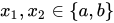
By the Weierstrass Theorem, the function has two extrema in , say a minimum and a maximum . There are two cases:
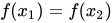
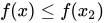
(i) If then (by the condition for Rolle's Theorem to hold). However, (as it's a minimum) and (as it's a maximum). So .
Therefore is constant on , so its derivative is 0 everywhere, so there certainly exists a with .
(ii) If the above case does not happen, then . So take , and as it is an extremum .
Lagrange's Mean Value Theorem
For any function that is continuous on and differentiable on there exists some such that the secant joining the endpoints of the interval is parallel to the tangent at .
Lagrange's mean value theorem, sometimes just called the mean value theorem, states that for a function that is continuous on and differentiable on :
Proof
Rather than prove this theorem explicitly, it is possible to show that it follows directly from Rolle's theorem. As we have already proved Rolle's, this is enough.
Define a function
Observe
And
Note that by the algebra of continuous and differentiable functions, satisfies the conditions for Rolle's Theorem.
So by the theorem, ,
So ,
i.e. .
Note also that Rolle's Theorem is a special case of Lagrange's MVT, where .
Cauchy's Mean Value Theorem
Geometrical meaning of Cauchy's theorem
Cauchy's mean value theorem states that for two functions that are continuous on and differentiable on :
Proof
Note: because saying the opposite will apply Rolle's Theorem that .
Again we can show this follows from Rolle's Theorem:
Define a function
Observe
And
Again, by the algebra of continuous and differentiable functions, also satisfies the other conditions for Rolle's Theorem.
So by the theorem,
So
i.e. .
Note that Lagrange's MVT (and therefore also Rolle's Theorem) is just a special case of Cauchy's MVT, where you take .

![{\displaystyle [a,b]}](https://services.fandom.com/mathoid-facade/v1/media/math/render/svg/f6257fd8e02b31abfa0fbeed7ab806e5d09a72d6)


![{\displaystyle f:[a,b]\to \mathbb {R} }](https://services.fandom.com/mathoid-facade/v1/media/math/render/svg/60c2de478e900d7d267cadc20ce588b9e6b6db8e)





![{\displaystyle \forall x\in [a,b],f(x)\geq f(x_{1})}](https://services.fandom.com/mathoid-facade/v1/media/math/render/svg/a15867f4eedb6ad983595eb98819780df9476714)
![{\displaystyle f(x_{1})\leq f(x)\leq f(x_{2})=f(x_{1})\implies f(x)=f(x_{1}),\forall x\in [a,b]}](https://services.fandom.com/mathoid-facade/v1/media/math/render/svg/e94f8ecf46be5de26c49293153ee371a9d97eee3)












![{\displaystyle f,g:[a,b]\to \mathbb {R} }](https://services.fandom.com/mathoid-facade/v1/media/math/render/svg/fc6d2bf8d209ee7deac4b425348858fcfbeac5d1)








![{\displaystyle g(x)=x,\forall x\in [a,b]}](https://services.fandom.com/mathoid-facade/v1/media/math/render/svg/d83688606ad90cf7d711616c9cdea4ff96b43bed)

