
A numeral is a symbol that represents a number — for example, 2 or 1729. A collection of such symbols is known as a numeral system or system of numeration (or, less formally, a number system — although the latter term technically has a different meaning)
Please see our list of number names and symbols for a table of numerals and corresponding number names in different languages.
The Natural numbers
Given a set of at least two digits, any natural number can be uniquely represented as a string of digits, with the leftmost digit being non-zero. That is, if is a set of digits, digits in can be used to represent (in base-) any natural number. The idea behind such representation follows from the following proposition:


Let be a natural number greater than 1. For any non-zero natural number M, there exists a unique natural number (representing the number of digits) and a finite sequence (representing the digits themselves) such that:


- for each ;
- , so that the leading digit is non-zero;


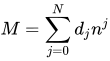
Then as has digits, there is a one-to-one pairing between the digits and the set of natural numbers that are less than .
Using the equality , we can conceptualize the representation as the concatenation: , where each is the digit in representing .



Common Numeral Systems
- The decimal system, using , is default decimal system used in everyday life.
- The binary system, using , used in computer science.
- The hexadecimal system, using , also used in computer science.


