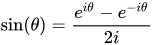
sin ( θ ) = e i θ − e − i θ 2 i {\displaystyle \sin(\theta)=\frac{e^{i \theta}-e^{-i \theta}}{2i}}
Euler's formula:
e i θ = cos ( θ ) + i sin ( θ ) {\displaystyle e^{i\theta}= \cos (\theta) + i \sin(\theta)}
Replace θ {\textstyle \theta} with − θ {\textstyle -\theta} :
e − i θ = cos ( − θ ) + i sin ( − θ ) {\displaystyle e^{-i \theta}=\cos(-\theta)+i\sin(-\theta)}
Cosine is an even function and sine is odd:
e − i θ = cos ( θ ) − i sin ( θ ) {\displaystyle e^{-i \theta}=\cos(\theta)-i\sin(\theta)}
Subtract the equation above from the original formula. (This is possible because you are taking away equavalent amounts from both sides):
e i θ − e − i θ = cos ( θ ) + i sin ( θ ) − cos ( θ ) + i sin ( θ ) {\displaystyle e^{i \theta}-e^{-i \theta}=\cos(\theta)+i\sin(\theta)-\cos(\theta)+i\sin(\theta)}
e i θ − e − i θ = 2 i sin ( θ ) {\displaystyle e^{i \theta}-e^{-i \theta}=2i\sin(\theta)}
e i θ − e − i θ 2 i = sin ( θ ) {\displaystyle \frac {e^{i \theta}-e^{-i \theta}}{2i}=\sin(\theta)}

 with
with  :
:


