A set is a collection of distinct, symbols in ordered objects. Sets are typically collections of numbers, though a set may contain any type of data (including other sets).The objects in a set are called the members of the set or the elements of the set. There are a few axioms in set theory, called ZFC (Zermelo-Fraenkel Choice). The axioms are: 1. Axiom of Extensionality &\forall&A(&\forall&B(&\forall&x((x$\in$A $\leftrightarrow$ x$\in$B) $\rightarrow$ A=B)) 2. Axiom of Foundation 3. Axiom Schema of Seperation 4. Axiom Schema of Replacement 5. Axiom of Pairing 6. Axiom of Union 7. Axiom of Infinity 8. Axiom of Power Set 9. Axiom of Choice
Set notation
Sets are notated using french braces {,,, ,,, ,,, } with delimited by commas. There are three ways to represent a set.
- Roster Form - A set may be described by listing all its members and then putting curly brackets or braces { }. This is called roster or tabular form.It Can be stated in two ways:-
- Strict enumeration - each element in a set is explicitly stated (e.g.,).
- Pattern enumeration - sets with elements following a clear pattern can be shortened from strict enumeration by only showing enough elements to describe the pattern and representing the rest with an ellipsis (e.g.,).


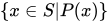
- Set former (or set builder)- A set may be described as {x|x has property p}. This is called rule method or set builder form. Elements in a set are defined as a function of one or more variables in a given domain that meets a condition. The presence of a condition is optional. Some syntaxes and variations for a set former are as follows:
- For example, defines the set of integers 1 through 10.
- , given a function and predicate , the set of all values for which is true.
- , given a set and predicate , a subset of all in for which is true.






Set properties and operations
Several properties and operations have been defined for sets. For the purpose of this section, sets are assumed to be collections of numbers. Set
is defined as the set
.
Properties
- An object is an element of a set when it is contained in the set. For example, 1 is an element of . This is written as . Similarly, the fact that 11 is not an element of is written as . The universe (usually represented as) is a set containing all possible elements, while the empty set or null set (represented as or) is a set containing no elements.
- The number of (different) elements in a set is called the Cardinal Number of the set.Thus the cardinality of a set is the number of elements in the set. The cardinality of (written as or) is 10. The Carrdinal Number of a Null Set is 0, for an Infinite Set it is not defined and for a Singleton Set, it is 1.
- Two sets are called equal (written as A B) if they have the same elements.Two finite sets are equivalent if they have same number of elements. Thus "All equal sets are equivalent. But all equivalent sets are not equal" i.e. A B if n(A) = n(B).
- The complement of a set is the set containing all elements of the universe which are not elements of the original set. For example, if the universe is defined as , then the complement of with respect to (written as) is . The cardinalities of a set and its complement together equal the cardinality of the universe. Thus, the universe and the null set are complements of each other.
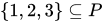
- A set is a subset of another set when all the elements in the first set are also a member of the second set. Given sets , is a subset of , notated as , if and only if for all , implies . All sets are subsets of the universe. By definition, all sets are subsets of themselves and by convention, the null set is a subset of all sets. For example, . Any given set has subsets.
- Set A is called subset of B if every element of A is also an element of B. We write it as AB (read as "A is a subset of B" or "A is contained in B"). In such a case, we say BA ("B is a superset of A" or "B contains A").
- Two sets are equal if they are subsets of each other.
- Set A is called a proper subset of set B if every element of A is element of B but there exists at least one element of B which is not an element of A.
- A set's proper subsets are all subsets except the set itself. This relationship is notated by









Operations
- The union of two sets is the set containing all elements of either or , including elements of both and . This operation is written as . For example, .
- The union of sets A and B, written as AB, is the set consisting of all elements which belong to either A or B or both.
- The intersection of two sets is the set containing all elements of both and . This is written as . For example, . The sum of the cardinalities of the intersection and union of two sets is equal to the sum of the cardinalities of the two sets.
- The intersection of sets A and B, written as AB is the set consisting of all the elements which belong to both A and B.
- n(AB) = n(A) + n(B) - n(AB).
- If A and B are two sets, then difference of A and B is the set A -B consisting of all the elements which are elements of A but are not elements of B.
- Complement of a set A, written as or is the set consisting of all the elements of which do not belong to A.
Thus A' = {x | x and xA}. - In Venn diagrams, sets are represented by closed figures like rectangle, circle, oval. Elements of the set are shown as points inside this figure. Usually the universal set is denoted by rectangle and its subsets by closed curves (circles etc.) within this rectangle.






Other functions on sets
Some functions on sets return a set which may not necessarily be a subset of the universal set. Given sets
and

- The Power set of , denoted, is the set containing all subsets of .
- The Cartesian product of and , denoted , is the set of ordered pairs where and . That is, .



Types of Sets
- An infinite set has unlimited number of elements.
- A finite set has finite, countable number of elements.
- An empty set or null set or void set has no elements. It is written as { }.
- The equal sets-' two sets are equal if they have the same elements'.
- Two sets are called disjoint if they have no elements in common.
- Two sets are called overlapping if they have some elements in common.
- A set that contains all the elements under consideration in a given problem is called universal set. It is written as U.
- A unit set contains one element only.
- Two sets are called equivalent if they both have the same number of elements.