A vector space is an algebraic structure consisting of an additive Abelian group  (elements of which are called vectors, and are denoted in bold), a field
  (elements of which are called scalars), and a scalar multiplication function
  following these properties:
- Distributive property of scalar multiplication over vector addition: For all
 and
and  ,
,  .
.
- Distributive property of scalar multiplication over field addition: For all
 and
and  ,
,  .
.
- Associative law of combined scalar and field multiplication: For all and ,
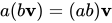 .
.
- Scalar multiplication identity: With 1 as the field multiplicative identity, for all , we have
 .
.
As both and each have their own respective additive identites, we will denote boldface  to represent the additive identity in . We then say that is a vector space over the field .
Definitions
- A subset
 is:
is:
- Linearly dependent if there exist (distinct) vectors
 and scalars
  , with at least one of these scalars non-zero, such that
 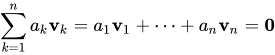 . Otherwise, we say
  is linearly independent.
- A spanning set if, for any there exist vectors and scalars such that
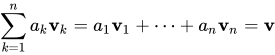 . That is to say, any vector in is a linear combination of vectors in .
- A basis for if is linearly independent and a spanning set.
- A subspace for if is also a subgroup and is closed under scalar multiplication: For any vector
 and scalar ,
  .
.
- Given two vector spaces and
 over a field , a function
  is a linear transformation if for any
  and ,
and ,  and
and  . In abstract algebra, this is known as a homomorphism.
Theorems
- If
 and
and  are bases for , then they have the same cardinality. That is, there exists a bijective function
  (proof). As such, we may define the dimension of as the cardinality of any basis for .
- Given a basis
 , and linear combinations
  and
and  , if
, if 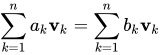 , then
  for each applicable
  . This is to say any vector in is a unique linear combination of vectors in .