- For the field in relations, see field (relation).
A field is a set paired with two operations on the set, which are designated as addition  and multiplication
  . As a group can be conceptualized as an ordered pair of a set and an operation,
  , a field can be conceptualized as an ordered triple
  .
.
A set with addition and multiplication, , is a field if and only if it satisfies the following properties:
- Commutativity of both addition and multiplication — For all
 ,
,  and
and 
- Associativity of both addition and multiplication — For all
 ,
,  and
and 
- Additive Identity — There exists a "zero" element,
 , called an additive identity, such that
  for all
- Additive Inverses — For each , there exists a
 , called an additive inverse of
  , such that
- Multiplicative Identity — There exists a "one" element,
 , different from 0, called a multiplicative identity, such that
  for all
- Multiplicative Inverses — For each , except for 0, there exists a
 , called a multiplicative inverse of , such that
- Distributive property — For all ,

- Closure of addition and multiplication — For all ,
 and
and 
Alternatively, a field can be defined as a commutative ring with unity (has a multiplicative identity) and multiplicative inverses.
We will often abbreviate the multiplication of two elements,  , by juxtaposition of the elements,
  . Also, when combining multiplication and addition in an expression, multiplication takes precedence over addition unless the addition is enclosed in parenthesis. That is,
  .
.
We can also denote  and
and  as additive and multiplicative inverses of any . Furthermore, we can define two more operations, called subtraction and division by
  , and provided that
  ,
,  .
.
Important Results
Because a field is also a ring with unity, these properties are inherited:
 is an abelian groups
 , for all
  , for all
  , for all
 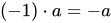 , for all
- Multiplication distributes over subtraction.
Additionally:
 is also an abelian group, where
  is the set of nonzero elements of
- Any field contains a subfield
 that is field-isomorphic to
  or
or  for some prime
  .
.
Optional Properties
A field is:
- A subfield of a field
 if
if  (see subset), where addition and multiplication on is a domain restriction on the addition and multiplication on . More commonly, we say that is an extension field of , and in fact, is also a vector space over
- An ordered field if there exists a total order
 on such that for all
  , if
, if  , then
  , (translation invariance), and if
  and
and  , then
Examples
- Under the usual operations of addition and multiplication, the rational numbers (), algebraic numbers (
 ), real numbers (
 ), and complex numbers (
 ) are fields.
- An extension field of , such as
![{\displaystyle \mathbb {Q} \left[{\sqrt {2}}\right]=\left\{a+b{\sqrt {2}}\mid a,b\in \mathbb {Q} \right\}}](https://services.fandom.com/mathoid-facade/v1/media/math/render/svg/d2c0f14eae1fd31473499f7772795953ef0585c0) .
.
Related
Elements of a field are the quantities over the vectorspaces are constructed and there are also called the scalars.
In the same branch functions  , where is a field are called scalar fields.