 |
This article is a stub. You can help Math Wiki by expanding it. |
This page has been nominated for deletion. Reason given: There is already a page 0 (number),
Can we merge the information on these pages together?
Administrators, please check the talk page and page history before deleting the page.
About
Zero is a number denoting the lack of any quantity or measure. In the Hindu-Arabic numeration system, it is denoted by the numeral 0.
In algebraic structures, zero is also a name given to an element in an additive monoid, group, ring, or field that acts as the additive identity, such as zero itself (in the context of real numbers), zero vector, zero matrix, and zero function. It is neither a negative or a positive number. 0 is also a palindrome. It is the first whole number and it exceeds -1 and preceeds 1.
Properties
- Neither negative nor positive.
- Anything multiplied by zero is zero, including zero multiplied by zero.
- Zero divided by anything is zero, except zero divided by zero is undefined.
- Anything divided by zero is undefined.
- Zero has the lowest possible absolute value.
- Anything to the power of zero is one. For example,
- Zero to any positive power is zero.
- Zero to any negative power is undefined (equivalent to ).
- Anything added to zero is itself, including zero added to zero.
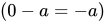
- Anything subtracted from zero results in a negative number, except zero (which has no sign).
- Zero is not a prime nor a composite.
- Zero is not a polygonal number.
- Zero is a square, a cube, and a tesseract number simultaneously.
- Zero is in the Fibonnacci sequence.
- There is no Roman numeral for 0; it is the only whole number without one.
- Its arabic numeral is an oval shape.


Is 0 odd or even?
The parity of 0 is even. In other words, its parity—the quality of an integer being even or odd—is even. This can be easily verified based on the definition of "even": zero is an integer multiple of 2, specifically 0×2. As a result, zero shares all the properties that characterize even numbers: for example, 0 is neighbored on both sides by odd numbers, any decimal integer has the same parity as its last digit—so, since 10 is even, 0 will be even, and if y is even then y + x has the same parity as x—indeed, 0 + x and x always have the same parity.


The box with 0 objects has no red object left over.
Divisors
0, 1, 2, 3, 4, 5, 6, 7, 8, 9, 10, 11, 12, 13, 14...
0 is a multiple of all numbers; however, no number besides it has 0 as a factor, and this is because factorisation is only defined for natural numbers.