The dot product is the most common way to define an inner product between elements of  (
( -dimensional vectors).
Note that some texts use the symbol  to denote the dot product between
  and
and  , preserving the inner-product notation.
The dot product is one of three common types of multiplication compatible with vectors; the other being the cross product and scalar multiplication, the latter belonging to the vector space nature of .
as an inner-product space
We will now prove that the dot product  turns into an inner-product space. There are four statements to prove, namely, given any
  and any scalar
  , the following is true:



 with equality if and only if
- Proof.
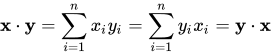
 , where we in the second step factored out the

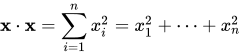 . But each
  (
( ), so , as required. Now suppose that . Then clearly
 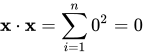 . If
. If  , then
  . Suppose for the sake of contradiction that some
  . Then
  so that
  . But this is a contradiction, so we must have
This completes the proof.
Euclidean norm and  as a metric space
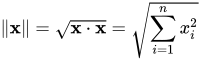
Once we have defined the dot product between elements of Euclidean -space, we may define a map  , when applied to
  is called the norm of .
One can show that if and  , then
  is a valid distance between and , and hence turns into a metric space. In fact, this metric space is complete, meaning that every Cauchy sequence of elements in converges to some point in .
Angles between two elements
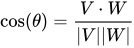
The dot product can be used to determine the angle between two elements:
Orthogonality
Two elements in an inner-product space are said to be orthogonal if and only if their inner-product is 0. In this translates to: and in are orthogonal if and only if  . Note that the zero vector is orthogonal to every vector.
See also