The absolute value of a real number  , denoted
 , is its distance from zero. It is the non-negative value of without regard to its sign. Namely,
  if is a positive number, and
  if is negative (in which case negating makes
  positive), and
  . For example, the absolute value of 3 is 3, and the absolute value of −3 is also 3.
| Definition
|
Absolute value of a real number
The absolute value of a real number n,  , is defined as , is defined as
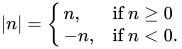
|
| Definition
|
Absolute value of a complex number
The absolute value of a complex number  is defined as is defined as
 equal to the distance between the number in the complex number plane and the origin. equal to the distance between the number in the complex number plane and the origin.
|
The definition may also be extended to vectors, where absolute value is often times called "magnitude".
| Definition
|
Magnitude of a vector
The magnitude of a vector  is defined as is defined as
 , is equal to the length or magnitude of the vector in question. , is equal to the length or magnitude of the vector in question.
Notice that magnitude is sometimes denoted with a double stroke absolute value

|
The absolute value signs are also used in set theory to indicate a cardinality, or set size. The operation measures the magnitude of a set, or in other words, the operation counts the number of elements a set contains.
| Definition
|
Cardinality of a set
The cardinality of a set  containing seven elements is defined as containing seven elements is defined as
 , the number of elements in the set. , the number of elements in the set.
|